Decisions fail long before execution. D-NAV shows you where.
D-NAV helps you see the pressure, return, and stability behind decisions—before momentum locks in.
One decision. Five variables. Immediate clarity.
Decisions rarely collapse because of effort. They fail because pressure, risk, and stability were never surfaced before commitment. D-NAV makes that friction visible early, so execution teams inherit a plan that has already survived scrutiny.
Decision friction D-NAV removes:
- Endless debate without shared criteria
- Confidence masquerading as certainty
- Pressure discovered too late
- Execution teams inheriting unresolved risk
These aren't execution problems. They're judgment problems.
When D-NAV is the right tool
When decisions feel urgent, complex, or irreversible—and no one can clearly explain why they feel that way.
D-NAV surfaces the pressure, return, and stability dynamics already shaping the outcome.
Engagements begin with one decision and expand into audits and consulting work.
What actually drives this decision
Breaks a decision into five variables so hidden pressure and weak assumptions become visible.
Cross-engagement patterns
Reveals how decisions cluster over time—where judgment is stable, strained, or inconsistent.
Stress-test judgment
Compares decisions across domains to expose imbalance before it becomes failure.
Engagements include Decision Checks, audits, and pre-commitment reviews delivered with the same system language.
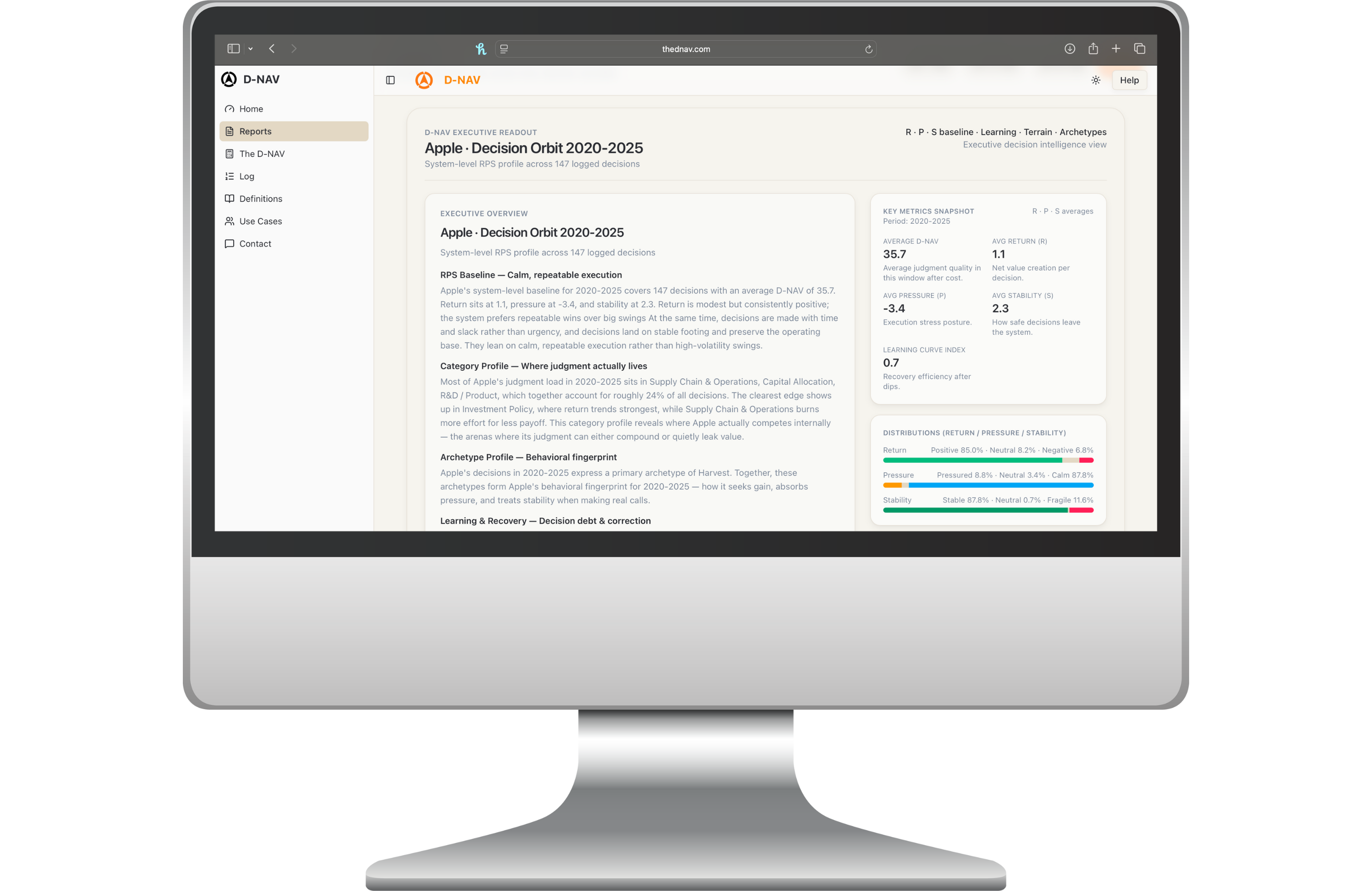
Executive Readout
A pre-commitment decision brief, built to survive scrutiny.
Built for boardrooms, diligence reviews, and executive sessions where judgment must be defensible.
D-NAV translates the system grammar into a concise brief that makes pressure, risk, and stability legible before any commitment.
It shows how judgment is applied, where hidden pressure sits, and whether stability can absorb the move — the evidence executives expect in the room.
The readout is a consulting deliverable designed to reduce slideware and eliminate post-hoc storytelling.
The goal is a plan that has already survived questioning.
The readout is a consulting deliverable that makes the decision legible before execution.
Entity Compare
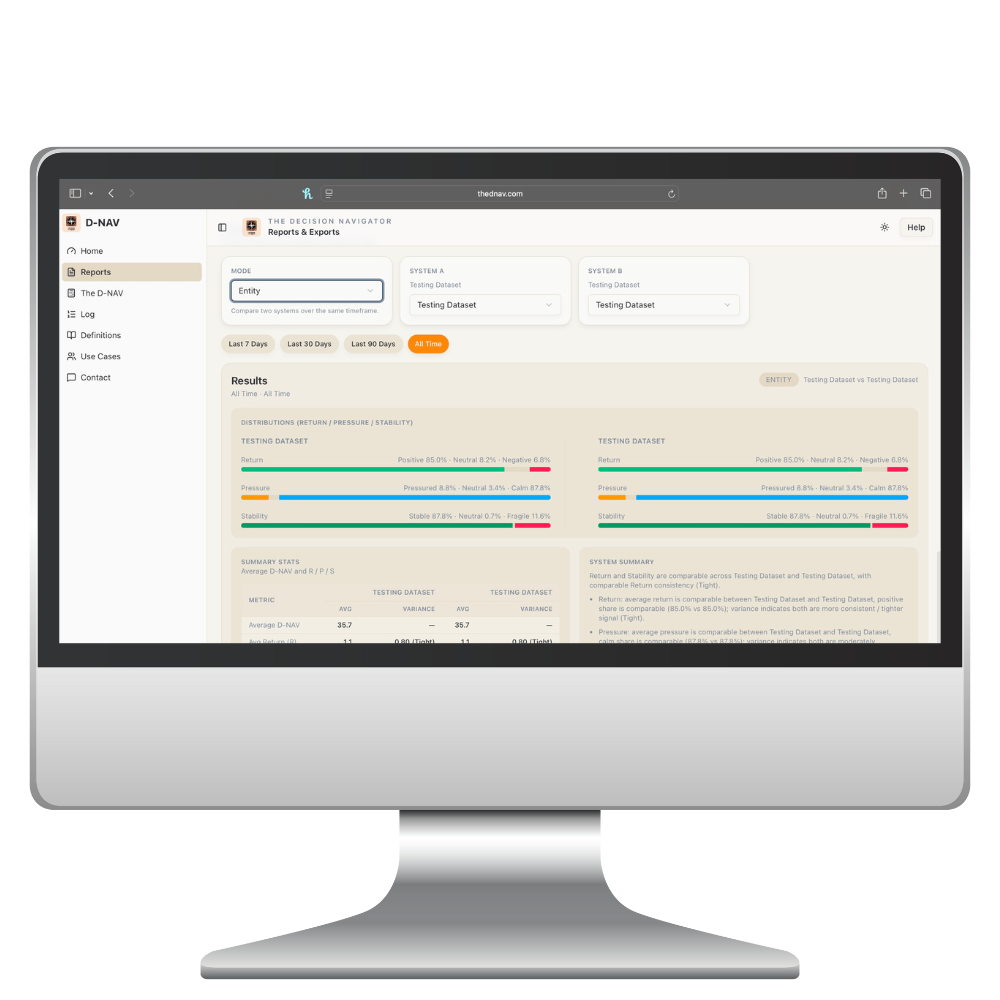
Judgment becomes clear when contrasted.
Once decisions share the same system language, comparison moves from opinion to evidence.
D-NAV stacks teams, strategies, or domains side-by-side to reveal where judgment earns return and where it quietly accumulates pressure before the work starts.
What appears solid in isolation often fractures under contrast — the moment to adapt before commitment, not after.
Same decision language. Very different outcomes.
System grammar
Under the hood: RPS + D-NAV
D-NAV doesn't tell you what to decide. It shows you how your decisions behave under pressure.
Return, Pressure, and Stability describe the geometry of a decision—not its outcome.
RPS is the internal signal. D-NAV is the consulting readout.
One language for Return, Pressure, Stability. Inputs are captured once, then translated into decision checks, audits, and pre-commitment briefs with the same score. The internal frame is Merit (Impact − Cost − Risk) and Energy (Urgency × Confidence); the readout is Return, Pressure, and Stability.
Upside after cost and risk.
Where urgency and confidence strain the plan.
Downside tolerance.
RPS turns five inputs into internal logic and a consulting readout:
- Merit = Impact − Cost − Risk
- Energy = Urgency × Confidence
- Return, Pressure, Stability translate Merit and Energy for the consulting brief.
D-NAV Score
See the score before the market does.
D-NAV is the consulting readout. Merit = Impact − Cost − Risk. Energy = Urgency × Confidence. Pressure and Stability show where Energy strains the plan. Together, they reveal whether the Merit holds and whether the team can carry it.
D-NAV = Merit + Energy
Merit = Impact − Cost − Risk. Energy = Urgency × Confidence.
Pattern recognition across engagements.
Breakthrough, Drift, Strain, or Coast — drawn from recurring engagements. Patterns show whether performance is repeating or sliding before you commit.
Descriptive, not prescriptive — they flag when to adapt or defend.
- Spot recurring pressure spikes across similar calls.
- See what repeatedly creates stability.
- Catch drift early and know when to adapt versus advance.
Compare
Side-by-side stress tests show where plans break under pressure before commitment.
Entity
Line up options to see what compresses Return or inflates Pressure.
Adaptation
Watch inputs drift and spot the adjustment window before stability snaps.
Decision NAVigator
Built for people who plan in uncertainty
D-NAV is used by people who make decisions before the data is clean—leaders, operators, coaches, and planners whose judgment shapes outcomes long before execution begins.
Operators — balancing speed and stability under real constraints
Leaders — making irreversible calls with incomplete information
Coaches — diagnosing judgment patterns, not just results
Start with a decision check. Expand to an audit.
Begin with one decision. If the pressure shows up, move into a decision audit or a pre-commitment consulting engagement.
Built to serve advisory, diligence, and boardroom contexts.
You don't need better answers.
You need better questions earlier.